Wednesday, July 23, 2014

Day 47: Bahai, Monarch, and Amslack

Day 47:  Tuesday July 22nd, 2014.
Wilmette (North Chicago), IL to Chicago, IL.  14.6 miles.

Up early, I was served a delicious omelet by Susan, made with fresh veggies from her garden.  Knowing that when I last used my tent at Blue Mound State Park, I packed it up wet from the morning dew, Susan allowed me to use her clothes lines to dry out my tent before heading into the city.

I said my goodbyes, thanking Susan and her family for their generous hospitality, and then made my way out of their neighborhood.  I was energized, knowing that I would see Victoria today, for the first time in a month, since Missoula, Montana.  Her train was scheduled to arrive around 4 pm, coming from Portland Oregon where she started two days prior, having traveled through many of the same towns that I rode through.  So, I had lots to do in preparation for her arrival, in addition to riding the short 14 more miles into the city.

Following my GPS, I rode through residential streets of Wilmette and Evanston.  Fancy homes gave way to neighborhood shops and restaurants around Northwestern University.

Susan prompted me that I would ride by the Bahai Temple, the only one in North America.  Not knowing what I was looking for, it was obvious when I came upon it.

I don't know anything about the religion, but the temple was very impressive with lots of ornate detail.

I stopped at a Coffee shop in Evanston for some caffeine and to catch up on some writing.  Sitting at the narrow bar against the window, I had a great view of life passing by on the street.

While here, I also wrote a note to Victoria in a card adorned with a monarch butterfly on the front that I found along the way.

I thought it was appropriate, as Victoria has a special connection with Monarchs. She has been raising them for over a year now, successfully providing the necessary environment in our back yard to allow them to carry out their life cycle from larvae to caterpillar to crysalis to butterfly.

We have watched closely the various stages of the process, including capturing video of a butterfly emerging from it's crysalis.  And, ever since I left the Pacific Ocean on this trans-America bike ride, I have encountered an occasional monarch crossing my path, in the Columbia River gorge, through the Rockies, over the Prairie grasslands, on the Plains, and alongside the Mississippi River.  I've thought of them as a reminder of Victoria, as if she had been alongside me all the way, and this card would be a perfect way to share that experience with her when she arrives.

My next stop would be a barber shop on Clark Street.  Along the way, I passed Wrigley Field.  The Padres are coming into town to play the Cubs tomorrow for a 3-game series.  I ordered some bleacher tickets for the Wednesday night game for myself, Victoria, and my nephew, Josh, who lives in Chicago.

Arriving at the barber shop, I leaned my bike on the window and entered to get a haircut and beard trim.  This was no "Man's Den", but it would have to do.  I asked the receptionist if it was ok to have my bike leaning on the window.  She replied, "Oh no honey - this is Chicago - you need to bring that inside."  I laughed inside, thanked her, and wheeled it in.  It was quite a sight to see it next to the chair where eventually a woman would be sitting as highlights were applied to her hair.

Clean-cut, I continued South on Clark Street, the bigger buildings of "The Loop" appearing in the distance, making my way to Division St.

At Division and Clark, I met my nephew Josh, an engineer, at his job site, the new Clark/Division subway stop.  I loitered in his office for a while as he finished up his workday.

Then, I rode a few blocks to his apartment.  He lives in a tall residential building near Lincoln Park, with a sensational view of Lake Michigan and the downtown skyline.  I took a tour of his place, including the rooftop lounge.

I locked up my bike at Josh's place, planning to store it for the next 13 days, while Victoria and I vacation in the area.  When Victoria returns to San Diego on August 5th, I will resume riding right where I left off, at Josh's apartment.

I proceeded by way of a cab to the Air-BnB rental that Victoria secured for the two of us to stay in while in Chicago for a few days.  Then, we plan to rent a car and travel around Northern Illinois and Southern Wisconsin, relaxing and visiting relatives.

While she was scheduled to arrive at 4 pm, Amtrak takes a back seat to BNSF freight trains.  As a result of numerous delays, sometimes for hours while multiple trains passed by, her arrival was delayed by 8 hours.  I wanted to be at Union Station when her train pulled in, waiting to greet her with open arms.  When she informed me that she was arriving, I took the elevator downstairs, and began walking towards the station.

I hadn't even left the block I started out on when a few raindrops turned into a deluge, with sheets of rain streaming down from the sky.  I ducked under an overhang, then ran two storefronts over to a Dunkin' Donuts to take shelter.  The rain was coming down too fast to runoff and the streets began to fill with water.  In the few seconds it took me to get inside, my shoulders and head were sopping wet.

Lightning accompanied the storm, and was intense.  I pulled radar data up on my phone, and could see the big picutre of what was going on.  Arriving at the same time as Victoria, a line of intense thunderstorms moving slowly toward the Southeast had taken over the city.

I was stuck for the moment, and decided to run back to the apartment building to call a cab.  But, Victoria was ready to go, and hopped into a cab herself, headed to the apartment.  So, I waited for her in the lobby, my hair dripping, clothes soaked.

When her cab rolled up, I ran out to meet her, so happy that she had arrived to be with me.


Day 46: Case Closed, The Steepest Gradient Yet

Day 46:  Monday July 21st, 2014.
Waukesha, WI to Wilmette (North Chicago), IL.  90.5 miles.

Before going to bed, I sent out a few messages on WarmShowers.org, hoping to have a host in Northern Chicago for this evening.  Mike and Susan responded, and were happy to host me.  They were my first choice, as they are situated on my route and within a day's ride (albeit a long day).  With my destination determined, I set out for the North Chicago neighborhood of Wilmette.

My legs were a bit sluggish, their soreness a result of the long day yesterday on top of the cumulative effect of riding without a rest-day since La Crosse, subsequently having traversed across the state of Wisconsin in short order.

Starting out, I definitely felt the shock of being thrown into a major urban area, one that would not be defined uniquely from other places by way of open space, but rather a gradient of urban that would become more intense as I made my way toward Chicago.  My route, while still on fantastic bike trails, would follow massive powerlines, pass by not lakes and fields, but industries, power plants, industrial complexes, and residential neighborhoods.

Reprieve from the concrete and metal came by way of city parks with well-manicured grassy fields and trees.

I was on mostly bike paths, including the New Berlin Trail, the Oak Leaf Trail and the Robert McClory Bike Path.  Occasionally, I would transition to roads, then back onto trails.  Before Racine, I crossed over a Chicago-Milwaukee artery, Interstate 94.  

By the time I reached Racine, I was hungry for lunch.  I took a detour off the bike path and onto the streets, passing by boarded up warehouses and storefronts, a superfund site, and a school that had been fenced off.  This town appeared to be hurting.  

I chose a small family-owned diner for lunch.  While there, I asked the waitress what people in town do for work.  She replied, "People in town don't work - they're mostly on welfare."  She told me the story of her mother, a faithful long-time employee of the Case Company, working at the Racine manufacturing plant assembling tractors.

The founder of Case, arriving in the mid-1800's in the Racine area, built up the company over time.  Passing away in 1891, Jerome Case is buried in the Racine cemetery.  Eventually, the Case company became the Case Corporation in 1994, going public on the stock market.  Since that time, some jobs, manufacturing, and assembly have been moved overseas.  The Case tractor plant in Racine closed it's doors, like several other manufacturing operations in the town, dealing huge blows to the local economy and to the families of those who lost their jobs, including my waitresses' mother.  "The massive building doesn't even exist anymore - they tore it down in 2005.", she added.  Racine, a victim of the stock market, of a company directed by shareholders interested in the biggest returns, disconnected from the lives, livelihood, families, and towns that are behind the scenes of the trading floor.

Back on my bike, I rode through the South side of Racine on my way out of town, through the 2-3 story project neighborhoods.  It was depressing.  The bike path switched from paved to dirt, and was routed arcoss streets with no stop signs, making frequent, busy road crossings a challenge.  I couldn't imagine kids using this path, as it was dangerous.

Through Kenosha, I then crossed the state line into Illinois.  As I rode through Waukegan, the bike trail infrastructure improved, and I was back into a lush tunnel of narrow green, with residential areas on either side.

I was in the Highland Park area of North Chicago.  The bike path now paralleling the commuter train tracks, each station was bustling with people, dressed up in Summer casual clothing, sporting bags and baskets loaded with fine wine, cheeses, baguettes, and other picnic rations.  They were all headed for a common destination - the Ravina Festival, an outdoor Summer concert series in a park-like ampitheater setting.  The festival has been ongoing since 1904, and people are free to byo-anything.  I learned about where everyone was headed from a police officer directing traffic on a corner.  He said, "We love it because you get 15,000 people showing up, bringing their own beer, wine, whatever, and we never have a problem."

Ever since Racine, I had been riding along the shore of Lake Michigan, yet I hadn't once seen the lake, my view hidden by buildings and trees.  Finally, my first sneak-peak at the lake happened as I rode through Highland Park.

Just one block from the shore, my view was now being blocked primarily by massive mansions on the lake.  The ominous display of obscene wealth was dizzying, especially after having just been through the projects of the Racine area.

The gradient of wealth was incredibly steep, and by far the most dramatic visible diplay of the haves versus the have-nots I've seen across America.  Highland Park, and the lakeshore wealth, blended into Wilmette.  Little did I know, I would be staying in one of the wealthier neighborhoods along Lake Michigan.  I pulled onto the street where my hosts lived.  Huge old homes with big yards were the norm.

I rolled into the driveway and was greeted by Mike and Susan.  They were very friendly and invited me into their home, treating me as if I was family, providing me with a guest room and connected bath on the second floor.

They also invited me to dine with them.  I sat at the table with Mike, Susan, and their Sons on the deck in their back yard, big oak trees overhead, joining in on their conversation from time to time while eating from a fantastic spread of food.  Their two daughters, now grown up and out of the house, were a big topic of discussion.  Choosing unexpected paths relative to their wealthy parent's expectations, their daughters have exploited their creative sides, one studying to be a goat farmer/artisan cheese maker, and the other living at a Co-Op of sorts in the Berkeley area and working a social services-type job.

Mike told me that their daughter's creative and unique paths have enlightened Susan and him, introducing new perspectives that they may not have otherwise had.  But, he admitted that it sometimes can be a delicate topic of conversation to share the latest news about what their offspring are up to at neighbor get-togethers, among people that may not "get it", such as their friends and neighbors the Ricketts, who currently own the Chicago Cubs and Wrigley Field.  

Making vague references to his work on the trading floor, and "in the pit", I assumed that their wealth came from Wall Street, or the Chicago trading floor.  Regardless, they were a generous, family focused on learning, exploring, sharing, and branching out.

After dinner,  Mike and Susan walked me across the street and a block East through a narrow public access to a beautiul beach on Lake Michigan.
"So, how did you get involved in hosting bicyclists?", I asked.  Mike explained that one of their daughters had been on a long-distance bicycling tour recently, and used WarmShowers.org hosts along the way.  She convinced her parents that they needed to help her return the favor by hosting bicyclists passing through the Chicago area.

Retiring to the guestroom for the evening, my mind was racing.  I stared at the ceiling in bed for a while before falling asleep, thinking about the whirlwind tour of urban landscapes, of the incredible degree of economic disparity in what I saw today, and the power of the "free market" that is Wall Street, of what it can do to a town like Racine and to the family of the waitress that served me at lunch, as well as what it has done for a few families like that of my hosts that invited me into their home.


Sunday, July 20, 2014

Day 45: Mad Town, General Lee, Penny Farthing

Day 45:  Sunday July 20th, 2014.
Blue Mound State Park near Blue Mounds, WI to Waukesha, WI.  100.4 miles.

Waking up early, I started out on the trail just after 8:00 am.

My cousin Fay, through a texting-arrangement made last night, decided to ride his motorcycle 1.5 to 2 hours from the Freeport Illinois area Northward to intersect my path in-time for breakfast.  Excited to meet up with him, I pedaled with a purpose, and made great time to the nearby town of Mt. Horeb.  When I arrived in Mt. Horeb, a cute town full of woodcarvings, artists shops, and trolls, I grabbed a cup of coffee.

Fay was on his way, but he had at least 30 more minutes to go before reaching my path.  So, I decided to ride on to the next town of Verona, a suburb of Madison.  In Verona, a local recommended the Pancake Cafe.  We met up there, had a great breakfast, talked bikes, and convinced another Pancake patron to take a photo of us next to our "rigs".

Energized, I followed the bike path into the capitol city, Madison.  Situated between Lake Mendota and Lake Monona, and home to the University of Wisconsin, the city was very bike friendly. 

The dramatic architecture of the capitol building stood out in the skyline from most vantage points throughout "Mad." town.

The Military Ridge State Trail that I had been on met up with the Capitol City Trail as I passed between the two lakes.  Lots of people were out and about, biking, walking, jogging, and soaking up the sun.

On the outskirts of town, I connected with the Glacial Drumlin State Trail, another rail-to-trail path that would take me all the way to Waukesha.

About 20 miles East of Madison, the trail sliced through the town of Deerfield, and a trail-side bar/eatery called The Rail House.  Hungry, and impressed with the convenience of this place, I decided to stop for a quick bite to eat.

Inside, several regulars sat at the bar of this otherwise empty place.  I sat at a round table against the wall right next to the bar and took the waitresses' recommendation for the chicken alfredo pizza.  "It's the best frozen pizza you can get.", she said with confidence.  She told me that only one restaurant in each town can sell this type of frozen pizza, and The Rail House was that lucky place in the small town of Deerfield.  

As I worked my way through the cardboard crust of the best frozen pizza in town, two other frequent patrons walked in, their arrival welcomed by the others.  Both were in their 50's, thirsty for a buzz, with a lot to talk about.  They looked over at me and said with an inquisitive voice, "You must be the guy riding that bike outside?"  We talked about my bike for a short while, the focus on the clean welds, components, metal, and other physical aspects of the bike, until their usual topics of conversation resumed.

They started an intense discussion about the physics behind landing the Dukes of Hazzard vehicle, also known as the General Lee, on the other side of the massive jumps that Bo and Luke would use to break away from the police that were chasing them.  "What they didn't show you was how the Gen Lee broke apart when that car landed on the other side.", one of the men said.  He followed up with, "They had to rebuild that car over and over."  

"Fascinating knowledge", I thought to myself.  Their conversation evolved back into bicycles, but this time the focus was on their disgust of corporate America, specifically relative to their past careers with Trek Bicycle, headquartered in nearby Waterloo, Wisconsin.  I learned that one of the gentlemen was a former painter for Trek.  "I worked my ass off for that company, and nearing my retirement they canned me as they moved more and more of the jobs overseas.", he said with disgust.  He told me that his job was to apply the paint on the bikes, and he was good at it.  "They had me custom paint the Trek bike that Robin Williams ordered.", he said proudly.

While Waterloo is still the site of some Trek manufacturing, most of the many jobs there are "white collar" type jobs held by people who think they are way too important, and are way overpaid, according to these former employees who were hiding their sadness behind a gruff and disgruntled exterior.

I paid for the check quickly after finishing my lunch, and broke away from this bar, eagar to get back onto the trail, hoping to make it all the way to Waukesha.

After about 10 miles of pedaling, the trail crossed over Rock Lake near the town of Lake Mills.  The lake was beautiful, and full of fishermen water skiiers, and boaters.  The trail turned into an expanded dock as it crossed over the lake, and several fishermen had used their bikes to reach the great fishing spot their lines were connected to.

I stopped for a few minutes to take it all in.  Then, as I started to resume, a peculiar fellow heading towards me on a..  ..bicycle?... called out to me as we were passing and we both stopped.

His name was Geoff.  He was very excited, as I was the first touring bicyclist he had encountered since he left on his own adventure.  He started in Toronto, Ontario Canada, and rode his Penny Farthing all the way to Lake Mills, WI.  But, he was just getting warmed up.  "I'm riding around the World!", he said with excitement.  Headed to Vancouver in British Colombia, he will then turn South and continue South until he reaches the Southern tip of South America.  He then plans to take a ship to the next continent, and continue riding.

My usual excitement that I experience when meeting another touring cyclist was a bit subdued by confusion.  I couldn't quite wrap my head around what I was seeing, let alone the story he was sharing.  After chatting a bit, we rode off in our own separate directions.  It took me several miles to sort out what had happened with this unusual encounter.

Getting close to Waukesha, I rode through a section of trail that was lined with "walls" of wild current, the branches laden with the bright red berries.  Then, the trail opened up into fields of soybean.  A few deer were in the field, helping themselves to a high-protien snack, looking up at me with a guilty expression as if they knew they were eating something that didn't belong to them.

Arriving in the old-town section of Waukesha, I went straight to a cafe for dinner.  The sparkling lemonade was a great refreshing end to a long day, and my sidewalk table with a view of the old architecture provided a perfect place to relax while searching on my phone for accommodations for the evening.

While there, the couple at the table behind me, seeing my bicycle leaning against the building, informed their waiter to put $10 toward my bill.  Before I became aware of the kind gesture, the couple had left their table.

Learning that Waukesha, a suburb of Milwaukee, was devoid of campgrounds, I grabbed a motel a couple of miles away for the night.  I felt good about the day's progress, as I was now only about 100 miles from Chicago where I would be meeting Victoria in 2 days.

Day 44: GMO OMG, Military Roads and Trails, Blue Mound

Day 44: Saturday July 19th, 2014.
Prairie Du Chien, WI to Blue Mound State Park, Blue Mounds, WI. 79.4 miles.

When my eyes opened on this morning in Prairie Du Chien, the sheen of amber-colored droplets resting on my tent caught my eye.  I was under a pine tree, and convinced myself that it was dew, and the yellow tint came from pollen, rather than the dreadful alternative - tree sap.  But, after packing up just about everything but the tent, I had to find out.  I took a small sponge with soap and water that I use for cleaning dishes and applied it to one of the globular droplets, hoping that it would disappear into the sponge.  It didn't.  Despite the soapy sponge, the sap, with it's incredible stickiness, left a glue-like residue on the tent and sponge after cleaning.

I made my way into the town center for breakfast at a coffee shop.  Discarded on the table I chose, a used copy of today's Telegraph Herald newspaper, a paper from nearby Dubuque, Iowa.  As I ate breakfast, I read a headline story, "Railroad's Plan Still on Track in Prairie Du Chien".
I learned from this article that city officials voted not to fight plans to expand a frac sand transfer site, despite complaints from residents about dust, noise, and light pollution coming from the existing site.

The railroad wrote a letter to the Wisconsin Department of Natural Resources (DNR) citing the Commerce Clause in the U.S. Constitution, which they claim gives them right to break ground on Monday, despite the fact that no state or federal permits have been granted, nor any environmental impact studies conducted.  As part of the expansion, the railroad plans to add a 7-track rail storage yard to be built on a wetland site in the Mississippi River floodway, currently regulated by the Wisconsin DNR.  The project is exempt from the city's zoning ordinances too.  One thing is for sure - Wisconsin is "Open For Business" when it comes to getting the much needed frac sands to the oil companies of the Bakken.

I followed the voice coming from my GPS as I headed out of town.  Initially riding on the same Great River Road, I was comfortable with the directions I had been given.  Along the way, I crossed the Wisconsin River, near the juncture where all of its water is forfeited to the Mississippi.

As I approached the transition from the Great River Road I was on to Highway 18 East, my GPS led me on a shortcut up Hicklin Hollow Road.  Questioning its authority and intelligence, I stopped at the intersection of this road, as it was gravel.

I usually try to avoid gravel roads because of less traction, more effort, more risk for flats, and more tire wear.  But, this shortcut was about 2 miles and the road surface seemed to be ok at the beginning.  Committed to it, I took the shortcut, only to find out that the conditions were worse than I had calculated, and after a few bends, the road steepened.  I worked hard to maintain traction on the ascents, and I corrected often to keep my wheels in the cleanest of recent car tire tracks to avoid the bigger rocks on the road.

Finally arriving at the T-intersection of Highway 18, I turned into the shady pull-out at the corner to catch my breath before continuing on.  There before me, a historical marker highlighting the fact that I was on, and would be continuing while on Highway 18, the Old Military Road.  This road connected Fort Howard on Green Bay to Fort Crawford at Prairie Du Chien, built in 1835.

I would be continuing down Highway 18 until I reached Dodgeville, at which point I would transition onto a bike trail and proceed almost exclusively off the road until I reached Lake Michigan over the next two days.

Along the way, I passed by a field of soybeans with a sign identifying the seeds being used that have since grown into the lush healthy vegetation extending out across the horizon.  The sign read, "Pioneer 92Y51".

Presumably, the sign is placed to show off the productivity of a particular "brand" of seed.  I'm not sure what would compel the farmer to do such a thing, unless he/she was paid to do so, or if the seed company owned the field.  It was interesting to say the least, and compelled me to pay closer attention to these signs, and to learn more about it.

I decided to do an Internet search to find out more about these particular beans.  The parent company with proprietary rights to the seed variety is a familiar name - DuPont.  Don't they make carpet?  These GMO beans contain genes that, among other traits, confer a tolerance to glyphosate, the primary ingredient in the herbicide Roundup.  These soybeans are thus "Roundup Ready".  Spray away!

A bit further, I came upon a field that had alternating rows of different seeds, with at least 12 signs highlighting the particular brand and model.

Looking up just one of these varieties, the "Croplan 4975VT3P RIB" variety, I found that it was a GMO produced by Monsanto (the same company that produced Agent Orange, DDT, Aspartame, Petroleum-based fertilizers, RoundUp, Saccharine, bGH-bovine growth hormone, and more), boasting their proprietary "Genuity VT Triple Pro Corn with RIB Complete" technology.  This corn has been genetically modified to provide "protection" from below-ground insects, specifically corn rootworm, and "dual modes of action for above ground insect protection", according to the Monsanto website.  And the corn has the "Roundup Ready - 2 Technology" genes that allow broad-spectrum Roundup herbicides to be applied at higher rates over longer periods through the growth of the corn without harming the corn, and killing everything around it. 

Alas, a different brand of soybean.  Could this one be a non-GMO?  The sign read, "Asgrow AG2431". 

Nope.  Not only was this another GMO crop, it was also a trademark name of the Monsanto Corporation, and contained some of the same pest-control genes and "Roundup Ready" genes as the others.  On the information sheet about this seed, a note to farmers reads, "Patented germplasm is licensed only to grow a single commercial crop of harvested material for use or sale for food, feed, processing, or fiber.  No license is granted for subsequent germinations of seed or plants for any purpose."  Thus, farmers can't create a seed bank from these plants, and must purchase seeds each year from Monsanto, the corporation that holds the "license" to this food.

On further investigation, Monsanto markets their proprietary seeds under 18 different names.  Some of them, like Dekalb, used to be an independent source of seeds, now just a front for the Monsanto name.  Other Monsanto names include Channel, Deltapine, Seminis, Gold Country Seed, Stewart Seeds, Rea Hybrids, Jung Seed Genetics, Lewis Hybrids, Hubner Seed, Fontanelle Hybrids, Trelay Seeds, De Ruiter, Stone Seed Group, Westbred, and Kruger.  Monsanto owns close to 1,700 patents for seeds, plants, and chemicals.

I found only one field of locally produced seeds in the Mt. Hope area of Wisconsin, advertized as Kussmaul.  While a family-operated company, the billboard next to their field boasts "elite genetics".

I wondered just how much of the crops grown in the U.S. are genetically modified Monsanto products.  According to organicconsumers.org, 40% of U.S. cropland, or around 151 million acres, are grown from Monsanto seeds.  And, 40% of the World's GMO crops are grown in the U.S.

All of this brought into real focus for me, the questions and issues of such widespread use of these genetically modified plants without full understanding of the impact of their use on the environment and on the people and animals that consume them, as documented by such great films as Food, Inc. and Vanishing of the Bees.  
    (1947 Pennsalt Chemicals DDT Ad)

I emerged from yet another GMO field of corn into the town of Montfort, and came to a large stand-alone store, home to Rural Route 1 Popcorn.  Really?  A huge stand-alone popcorn store?  There was no way I was going to pass this opportunity up.  See corny picture below (GMO? - I don't know).

Besides selling bags of white and yellow popcorn kernels, they had the buttered and salted popped version for sale, and a huge assortment of different flavored popcorn as well, including chocolate, caramel, cheese, and more.

Continuing East on Highway 18, as I pedaled out of Montfort, I followed a trail of popcorn scattered along the shoulder of the road for miles.  I guess the patrons busting into their fresh bags were eating it with the windows down as they drove down the highway.

Reaching Dodgeville, I had a quick bite to eat before pedaling onto the Military Ridge State Trail.  An old rail line converted into a bike path, this trail would lead me all the way to Madison, Wi.

The surface, crushed limestone, was not as smooth as those trails with the same surface type in Minnesota.  And, Wisconsin charges $4/day to use the trails.  But, relative to most states in the U.S., the trail was a welcomed relief from riding on the roads alongside traffic.  And, the tunnel of green was spectacular.

I emerged from the forest in the town of Ridgeway, arriving at the old 
Ridgeway Train Depot.

Back into the forest briefly, I then passed through Barneveld, the last small town before reaching my desitnation for the evening.  Barneveld was recently featured on the show, "Tree House Masters", and is known for it's wood carvings and mythical troll presence.

The forest became more dense after Barneveld as I entered Blue Mound State Park.

The bike trail traverses right through the park, and runs adjacent to the park campground, with a separate camping area alongside the trail dedicated to bicyclists.  The biker section of the campground was full, and I squeezed into an occupied site with permission for the night.  Being a Saturday, there were quite a few people from Madison, about 30 miles to the East, that hopped onto their bikes and rode to the park to camp for the weekend.

Friday, July 18, 2014

Day 43: Into Iowa, Skinny Dipping, Myrtle The Turtle

Day 43:  Friday July 18th, 2014.
La Crosse, WI to Prairie Du Chien, WI.  66.7 miles.


Up early, and reluctant to leave such a beautiful setting, I was fortunate to not have to decide whether or not to stay another day.  A wedding and reception scheduled for the weekend prompted the resort to setup tables, chairs, runners, and decorations, all unfolding around my site as I was packing up.  My site was in the middle of it all, and thus not available for the weekend.
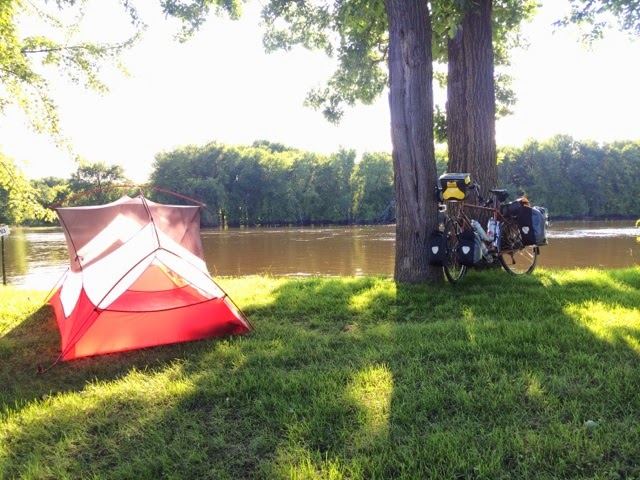
The Great River Road continues South on both the Minnesota side as well as the Wisconsin side of the Mississippi.  I could take either route, and decided to follow the Minnesota side for the first part of the day.  Leaving the island, I pedaled over the river to La Crescent, then proceeded South, continuing to ride the floodplain along the bluffs.

As the road merged with the river, an overlook provided a great expansive view of the Upper Mississippi River National Wildlife and Fish Refuge.  Stretching 261 river-miles from Wabasha, Minnesota to near Rock Island, Illinois, it has been a haven for fish, wildlife, and people since 1924 while protecting 240,000 acres of Mississippi River floodplain.
A sign at the site explains that this refuge hosts 306 species of birds, more than 250 bald eagle nests, 5,000 heron and egret nests in 15 colonies, 50% of the world's canvasback ducks, 20% of Eastern U.S. tundra swans, 51 species of mammals, 42 species of freshwater mussels, 119 species of fish, and 3.7 million visitors per year.

About 25 miles down the road, I crossed the state line from Minnesota into Iowa.  I had been skirting back and forth along the Minnesota and Wisconsin line over the past few days.  This was my final departure from Minnesota.  With "Fields of Opportunities", Iowa will be the 8th state I will be riding in.

Highlighting the scenic, but rugged topography immediately surrounding the flat floodplain along the Great River Road of Iowa, I was now on the "Driftless Area Scenic Byway".

Greeting me across the state line was the town of New Albin (pop. 522).  By now, I was pretty hungry, and looking for a place to eat.  On the main highway heading through this small town is a red barn-like building with a few small windows and one door.   There's no sign out front to indicate what might be inside.  The only hint I could work with was the neon signs in the windows, one for Budweiser, the other for Bud Light.  I decided to peek my head in the door, hoping it was a place to eat.

Inside, a full bar with tables, a few of them occupied by locals taking a lunch break.  This was a classic small-town eatery - a bar and grill, with the expected menu items presented on the wall-mounted menu board.  I had the 4-piece fried chicken with hash browns and coleslaw.  While eating at a corner table near the bar, I took in the scene.

A TV at the end of the bar played old episodes of Bonanza.  A sign over the hard liquor bottles read, "Taking my husband shopping is like going hunting with the game warden".  At the other end, a waitress chatting with a customer was asking, "Are you going to gather up bales of hay this weekend?"

Just then, a short, overweight man in his 60's wearing overalls and a plaid shirt walked into the bar.  The waitress already knew what he wanted.  She pulled out a cheap large bottle of wine, the bottle chilled and half full, the contents tinted pink, pulled a glass out, setting it in front of him as he arrived at his seat, and poured almost to the rim.  I looked away as I dove into another piece of chicken.  It could not have been more than 2 minutes before the wine in his glass was consumed.  He was already hailing the waitress down, signaling that he had made room in his now-empty glass for a second pour.  After about 10 minutes, his was finished, the second glass consumed, his check paid, and he was walking out the door to resume the day's work.  I could only hope that he was headed North, away from my route.

I cautiously headed South for another 12 miles to Lansing, Minnesota.  It was here that I would cross over the Mississippi River for the last time, transitioning back into Wisconsin, and leaving my trusty Adventure Cycling Route to make my way towards Chicago.  The Adventure Cycling route would have taken me further South in Iowa to Muscatine (near Davenport), before turning East heading through Northern Illinois, but avoiding the greater Chicago region all-together.  I needed to find a way to get into downtown Chicago in anticipation of my Wife's arrival on the 22nd of July.

Like a green beacon of light signaling my transition, I came upon a giant 2-scoop ice cream cone near the bridge crossing, at "The Skinny Dip" ice cream shack.

Their slogan, "Life is like ice cream - enjoy it before it melts!"  Not too clever.  But nonetheless, I stopped for a chocolate shake before proceeding.  The large group of motorcyclists behind me followed my lead as well, and the picnic table seating out front next to the road was suddenly bustling.

While eating my thick shake made of real ice cream with a spoon, I used the bicycle routing feature within Google Maps to calculate my route options.  I also had some recommendations from my Uncle Mike and Cousin Fay to determine the best way to go.  It was here that I realized the value of the maps I had been using all along.  Would Google Maps send me down a road with wider shoulders, smoother surfaces, bike lanes, less road construction, less traffic, not too steep, less blind curves, with services along the way, etc.?  I could only hope so, and chose what I thought would be the safest way to go using insight from my family.

Finishing the shake, and now feeling a bit heavier, I made my way over the all-metal bridge out of Lansing and into Wisconsin.   At the end of the bridge, I turned right and pedaled South on Highway 35, still following the Mississippi River in the floodplain, anxious about the inevitable departure I would have to make from it's edge, heading Eastward and having to climb up onto the bluffs, even though it wouldn't be until tomorrow that I would have to make the climb.

Whenever the road would dip down to the level of the river, wetlands would surround me, beaming with life.  In one such location, I watched as a large turtle  (I'll refer to her as "Myrtle"), her neck extended and head swaying back and forth, attempted to "dart" across the highway from the other side of the road.  There was a decent amount of traffic on this day, and vehicles were passing by in both directions at fairly frequent intervals, probably between 55 and 70 mph.

Myrtle was just as oblivious to the imminent danger ahead as the drivers of the oncoming cars.  As her neck crossed over the white line on the left, an oncoming car rounded the bend.  I was about 100 feet away, and I held my breath, neither Myrtle nor the car making any effort to deviate from their path to avoid a collision, Myrtle's momentum still moving forward.  Yet, somehow, as they passed each other in a fraction of a second, no collision occurred, and Myrtle hadn't noticed a thing.  I gasped for air, still moving forward myself, perpendicular to her path.

With Myrtle now in the center of the oncoming lane crawling towards the double-yellow, the driver of another car rounding the bend veers over the double-yellow line and into the opposite lane to avoid the creature.  Phew!

As I was now about 25 feet away from the scene, Myrtle now on the double-yellow, I glanced in my side mirror to see a large bus behind me, a second away from passing, that had veered into the middle of the road to give me more room, but consequently in a head-on trajectory with Myrtle.  

It was a split-second, the bus passing right over the top of Myrtle.  She disappeared from my sight at that moment.  I thought it was the end.  As her profile re-emerged, her arms, legs, and head were gone.  There wasn't any contact that occurred between the bus and Myrtle.  But, she noticed that time, and instinctively retreated to safety in her shell, as if that would have protected her. Her nose slowly emerged, then the rest of her head, trying to sense if her predator was gone.  Then, her legs popped back out and she was once again on the move.  By this time, I was alongside her.

I had to do something.  But, it was tricky, as cars trying to give me room, mainly, weren't focusing on avoiding her.  I stopped quickly, spending no time to carefully lay my bike down on the ground or lean it up against something as I usually do.  The bike flopped over on the shoulder, I saw an opportunity to run out and move her.

Still not having completely departed the double-yellow, I reached down from behind to grab her.  Her neck extended out, she whipped back around and snapped at my hand.  WHOA!  That was a close one.  No time to spare, I used my foot to slide her like a hockey puck across the lane.  Her feet clinging to  the pavement, she didn't move far.

As a car was approaching, slowing in response to the scene, I grabbed the edges of Myrtle's shell and carried her over to the shoulder next to my bike, her legs flailing around all the while.  She was heavy.  I took a quick picture, then used my foot to push her off the road completely, where she crawled down the slope headed to the marshland, her original destination.

I felt good about saving her, as the roads of the past 2000+ miles of my trip have been littered with a tremendous amount of death.  Far more than anyone would see from the vantage point of a car, I've witnessed over and over, a constant reminder of the toll that roads and their traffic take, a diverse and repetitive display of those who didn't make it.  I've thought about taking photos of the road kill I pass, sometimes curious about the species I encountered.  But, I would have to stop all-too-frequently to make any progress.

Most common, probably passing by at least 10-20 per day, are birds.  Many of them with intense colors of bright red, yellow, green, and sometimes blue, are often found on the shoulder, sometimes hidden slightly from the view of oncoming cars by grasses.  They're light and delicate, probably resulting in an impact that goes unnoticed by drivers.  Also very common are snakes, with turtles and frogs becoming equally as common East of Fargo.  I also pass by the remains of larger animals daily, often alerted to their presence by the smell, but also having to weave around them.  Deer, racoons, and in the West, porcupines were common.  But also, I've seen badgers, many rodents, antelope, fox, coyote, and other unrecognizeable animals.

Continuing on, I passed by one of several Army Corps of Engineers Lock and Dams that control the flow of the Mississippi and provide passage to the many boats and barges using the river for transportation.

A tugboat passed me pushing six massive barges, connected together, moving upstream.  Each was the same style as the one that I spotted in La Crosse that was loaded with sand.

Near the end of the day, I ended up at the town of Prairie Du Chien, Wisconsin.  More French than Chinese, the last part of the name is pronounced "sheen".  A small town on the Mississippi, it's a haven for river enthusiasts, providing a launching pad for house boating, river cruising, and watersports.  I ended up at the "Sports Unlimited" campground, which was packed.  While they didn't have any availability, sensitive to my inability to get much further down the road on a bike, they allowed me to pitch my tent between sites in a grassy area next to the restroom.  Many of the sites were occupied by what looked like long-term residents, with their custom firepits, sunshades, patio furniture, and other modifications adding a sense of permanence to the scene.  They were camped out for the Summer to take full advantage of all that the river had to offer.

The town was cute, with lots of neat shops and restaurants, some providing not-so-subtle reminders that I was in Wisconsin.